
Creative Accents: Incorporating Talavera Tile Beyond the Tabletop
August 13, 2025
Finishes: Protecting Your Custom Wood Furniture
October 13, 2025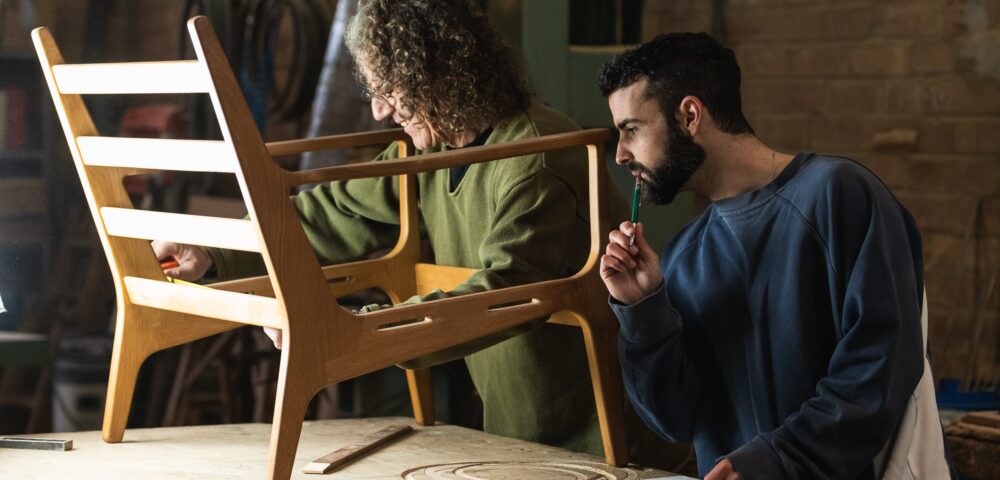
Custom furniture involves more than selecting beautiful wood. Furthermore, great builders concentrate on the technical excellence beneath the surface. True quality resides in the joinery, the precise methods used to connect pieces of wood. This technique determines a piece’s stability and, consequently, its lifespan.
Wood has natural properties; it expands and contracts with changes in humidity and temperature. Therefore, a joint must allow for this movement while maintaining exceptional strength. Simple construction often relies on screws or nails to hold wood together. However, these metallic fasteners can loosen over time as the wood shrinks and swells. Ultimately, this weakness leads to wobbly chairs, sagging drawers, and cracking tabletops.
Professional furniture makers reject these shortcuts. Instead, they rely on classic joinery techniques. These methods utilize the inherent strength of the wood itself. Specifically, the interlocking shapes and large glue surface areas create bonds stronger than the surrounding material.
Classic Joints for Custom Durability
The dovetail joint stands as a testament to durability. Artisans cut a series of interlocking “tails” and “pins” into the joining pieces. Consequently, the joint resists being pulled apart in any direction. Builders most commonly use this technique for drawer boxes, guaranteeing they withstand decades of pulling and pushing. This joint’s striking, visible pattern also showcases the builder’s skill.
Similarly, the mortise and tenon joint offers incredible structural integrity. Craftsmen cut a square or rectangular hole (mortise) into one piece of wood. Next, they shape a matching projection (tenon) on the end of the second piece. The tenon fits snugly into the mortise, forming an extremely strong connection ideal for securing legs to tabletops or rails to stiles. Throughout history, ancient civilizations used variations of this joint to build everything from temples to ships.
Another common method involves the biscuit joint. Carpenters cut small crescent-shaped slots into the mating edges of two boards. Then, they insert a highly compressed piece of wood (the “biscuit”), along with glue, into the slots. When the glue’s moisture hits the biscuit, it quickly swells, thus creating a tight, reinforced bond. Builders frequently use this joint for edge-to-edge applications, such as assembling wide tabletops.
Longevity Justifies Investment
Understanding joinery reveals why quality custom furniture commands a higher price. Indeed, building a complex joint like a dovetail requires significant time, skill, and precision tools. A maker must measure, mark, and cut the wood with perfect accuracy. Moreover, the process cannot be rushed; the builder focuses on the fit’s mechanical perfection before applying any adhesive.
This investment in technique yields clear, tangible benefits for the customer. Quality joinery prevents structural failure, ensuring the piece remains stable and beautiful for generations. Therefore, the piece becomes an heirloom, not merely a disposable item. You buy not just a table or a dresser, but a durable piece of functional art.
Choose furniture made by artisans who respect these time-honored techniques. Ultimately, this decision guarantees you acquire a piece of furniture built to endure daily life, becoming a lasting focal point in your space. Seek out the builder who showcases this dedication to the unseen details.